



The Fading Light of 3I/ATLAS: A Last Glimpse of a Visitor from Beyond

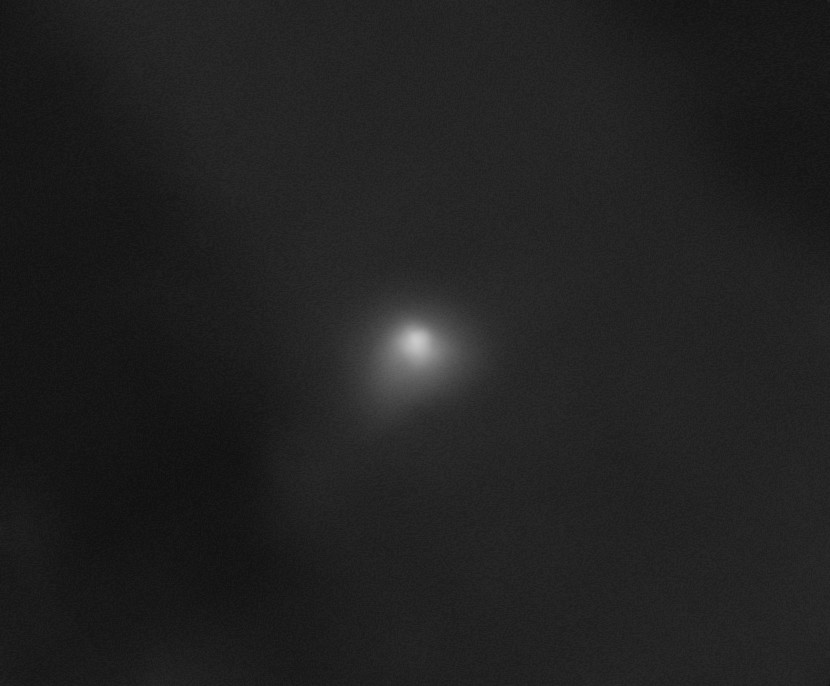
The SOHO spacecraft’s LASCO C3 coronagraph captured comet 3I/ATLAS as it reemerged from the Sun’s glare in November 2025. Image credit: NASA / ESA / SOHO.
A Visitor Revealed by Sunlight
When Comet 3I/ATLAS first appeared in our telescopes earlier this year, it carried with it the weight of the unknown. The third confirmed visitor from interstellar space offered more than scientific novelty. It was a reminder that the cosmos is restless, that even the quiet spaces between stars occasionally send us something tangible. Now, as 3I/ATLAS recedes toward the darkness beyond Mars orbit, the comet's light is beginning to fade, and the story it tells is coming into focus.
In late November, NASA's Solar and Heliospheric Observatory caught one final glimpse of the object as it slipped behind the Sun's glare and emerged again, weaker but still distinct. The small, pale arc of dust was nearly lost in the instrument noise, yet unmistakable to those who had tracked it for months. For scientists, that faint detection marked the closing chapter of a rare and coordinated effort—Earth-based observatories, spacecraft at Mars, and orbital telescopes all turning toward the same fleeting target.
A View from Mars
NASA’s Mars Reconnaissance Orbiter observed comet 3I/ATLAS from Mars orbit on October 2, 2025 — one of the first interplanetary views of an interstellar comet. Image credit: NASA / JPL-Caltech / University of Arizona.
What these last observations revealed was both reassuring and mysterious. 3I/ATLAS continues to behave like a natural icy body, releasing gas and dust in predictable ways. But its composition, measured in ultraviolet and infrared wavelengths, still defies easy classification. The ratio of carbon dioxide to water vapor is far higher than in typical solar system comets. That imbalance hints that this object was shaped in a colder, harsher environment, perhaps at the frozen edge of another star's protoplanetary disk, or in a region more exposed to stellar radiation. Whatever the origin, it is not like anything born near our Sun.
The Final Portrait

The Hubble Space Telescope captured this high-resolution image of comet 3I/ATLAS on July 21, 2025, revealing a bright coma and diffuse tail. Image credit: NASA / ESA / STScI.
There is a quiet melancholy in watching it go. Its brightness has dropped sharply since mid November. Soon it will slip beyond the reach of even our largest telescopes, returning to the anonymous drift between stars. Yet in the data it leaves behind lies something enduring. Every wavelength and pixel carries a record of chemistry that began around another sun, shaped by conditions our instruments can only imagine.
For now, astronomers are still parsing that record, measuring, comparing, and debating what it means. But for the rest of us, 3I/ATLAS leaves something simpler—a reminder that the solar system's boundaries are not walls but open doors. Visitors will come again, some icy, some rocky, perhaps stranger still. Each will carry the same quiet message this comet brought us, that the universe remains full of motion, memory, and grace.
As 3I/ATLAS drifts outward into the dark, its light diminishing against the stars, the story becomes less about discovery and more about connection. For a brief moment in time, a fragment from another world crossed paths with ours, and we noticed. That alone makes the fading light worth remembering.


Comments
Post a Comment